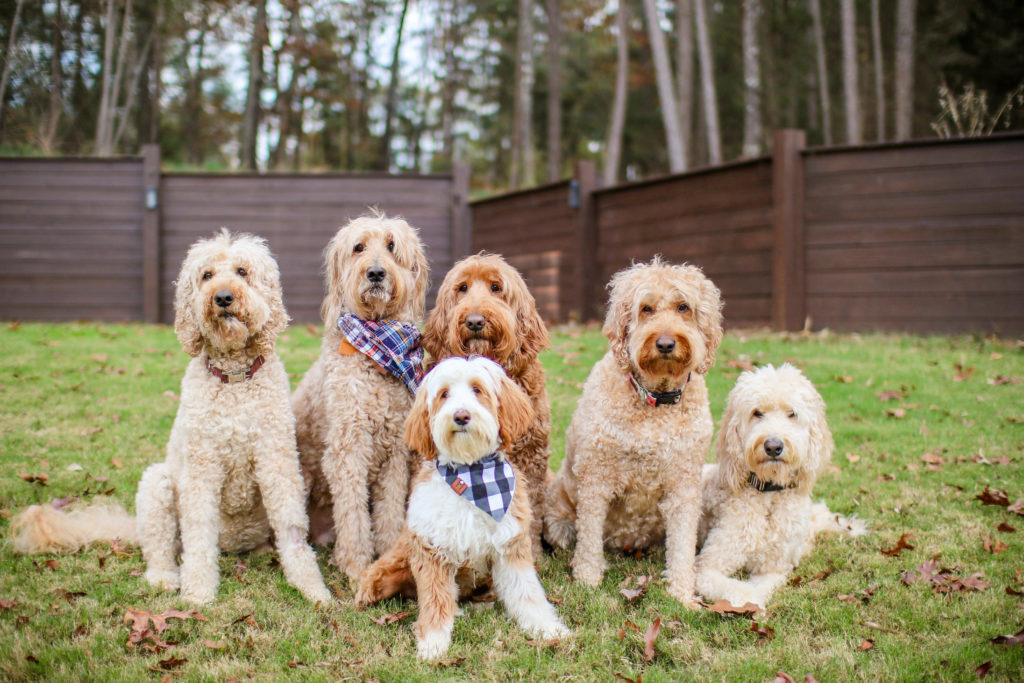
If you’ve been scrolling through doodle photos and stopped dead in your tracks at a black-and-white puppy with a perfectly white chest and paws — you’ve just met a Tuxedo Goldendoodle. They’re rare, they’re stunning, and BellaDoodles has been producing them since 2013.
What Makes a Tuxedo Goldendoodle?
A Tuxedo Goldendoodle is a Goldendoodle with a specific coat color pattern — a darker body (usually black, chocolate, or dark red) with a white chest, white paws, and often a white blaze on the face. The contrast makes them look like they’re dressed up for a formal event, hence the name “tuxedo.”
The tuxedo pattern comes from a specific combination of genes — the “parti” gene paired with the right base color. It’s not something you can simply breed for every litter, which is exactly why tuxedo Goldendoodles are so hard to find.
How Long Has BellaDoodles Been Breeding Tuxedo Goldendoodles?
We produced our first litter of Tuxedo Goldendoodles in August 2013 — over a decade ago. At the time, almost no one was producing this pattern intentionally. We fell in love with the look and the temperament of these dogs and have been refining our program ever since.
Because our BellaDoodles are multigenerational — meaning we breed Goldendoodle to Goldendoodle, not Goldendoodle to Poodle — we have much greater predictability in coat pattern, coat type, temperament, and health than early-generation breeders. Our 8th generation bloodline, started in 2010 with our original girl Bella, gives us a depth of knowledge about our lines that very few breeders can claim.
Are Tuxedo Goldendoodles Rare?
Yes — genuinely rare. The tuxedo pattern requires a specific genetic combination, and because most Goldendoodle breeders focus on solid red, apricot, or cream coats, the parti and tuxedo patterns are not widely produced. When families see a tuxedo BellaDoodle for the first time, the reaction is usually the same: “I didn’t know Goldendoodles came in that color!”
They do — and they’re just as low-shedding, just as intelligent, and just as human-like in personality as any other Goldendoodle. The only difference is the show-stopping coat.
What Sizes Do Tuxedo Goldendoodles Come In?
At BellaDoodles, our tuxedo Goldendoodles come in Mini (25–35 lbs) and Medium (35–45 lbs) sizes. We breed for manageable, family-friendly sizes that are easy to travel with, easy to groom, and comfortable in both homes with yards and more compact living situations.
What is the Personality of a Tuxedo Goldendoodle?
Identical to any BellaDoodle — loving, cuddly, incredibly smart, and deeply human-like. Our multigenerational breeding program prioritizes temperament above everything else. We breed for health first, then temperament and disposition, and then color. A tuxedo coat is a bonus on top of an already exceptional dog.
Our BellaDoodle families consistently describe their dogs as “not even like having a dog” — they’re that intuitive, that connected to their people, and that easy to live with.
How Do I Get a Tuxedo BellaDoodle?
The first step is submitting an application on our website. Tuxedo Goldendoodles are popular and don’t last long — families who are open to color and gender tend to get matched faster. Once your application is approved, you’ll be invited to our private Just BellaDoodles Facebook group where we share litter updates, puppy picks, and go-home day photos.
If you have your heart set on a tuxedo specifically, let us know in your application — we’ll do our best to match you with the right litter when one becomes available.
Ready to join the BellaDoodle family? Submit your application here and let’s get started.